


The Billion-Dollar Market That Does Not Exist: Why Market Size Alone Cannot Build a Startup

There is a number that appears with remarkable regularity in startup presentations: the size of the market. It is usually large enough to suggest an extraordinary opportunity and abstract enough that nobody has to explain how that opportunity will turn into revenue. One billion euros, ten billion, sometimes even a hundred. The market is enormous, therefore the company must have a bright future. Unfortunately, the two statements are missing the most interesting part: the mechanism by which a real customer is supposed to pay for a real product.
The total size of an industry is useful information, but it does not prove that demand is accessible to a particular company. Confusing these levels means mistaking contextual data for a commercial forecast. And when you are raising capital, that distinction is hardly trivial.
The Total Market Is Not Your Market
The familiar distinction between TAM, SAM, and SOM is intended to address this ambiguity. Total Addressable Market describes the theoretical overall demand for a category of solutions. Serviceable Available Market identifies the portion that can be served with a specific offering, geography, and delivery capability. Serviceable Obtainable Market attempts to estimate the share that could realistically be captured over a defined period, given competition, resources, and operational constraints.
The problem is not using these categories; it is filling them with arbitrary percentages. Writing that a startup will capture one percent of a billion-dollar market proves nothing if we do not know how many customers must be acquired, how much they will spend, how long the sales cycle takes, and what it costs to reach them. A small percentage of a huge number is still an invented number when the underlying economic mechanism is missing.
SOM should not be a more conservative version of a wish. It should emerge from testable assumptions about customer behavior and the organization's ability to serve those customers.
One Billion on Paper, Six Million in the Scenario
Imagine a startup presenting a theoretical market worth €1 billion. Once the segments it can actually serve are identified, the addressable opportunity falls to €120 million. Accounting for sales capacity, existing alternatives, and adoption timelines produces a scenario with €6 million in obtainable market share. None of these figures, by itself, tells us whether the company will succeed. Their relationship makes assumptions visible; it does not turn those assumptions into certainties.
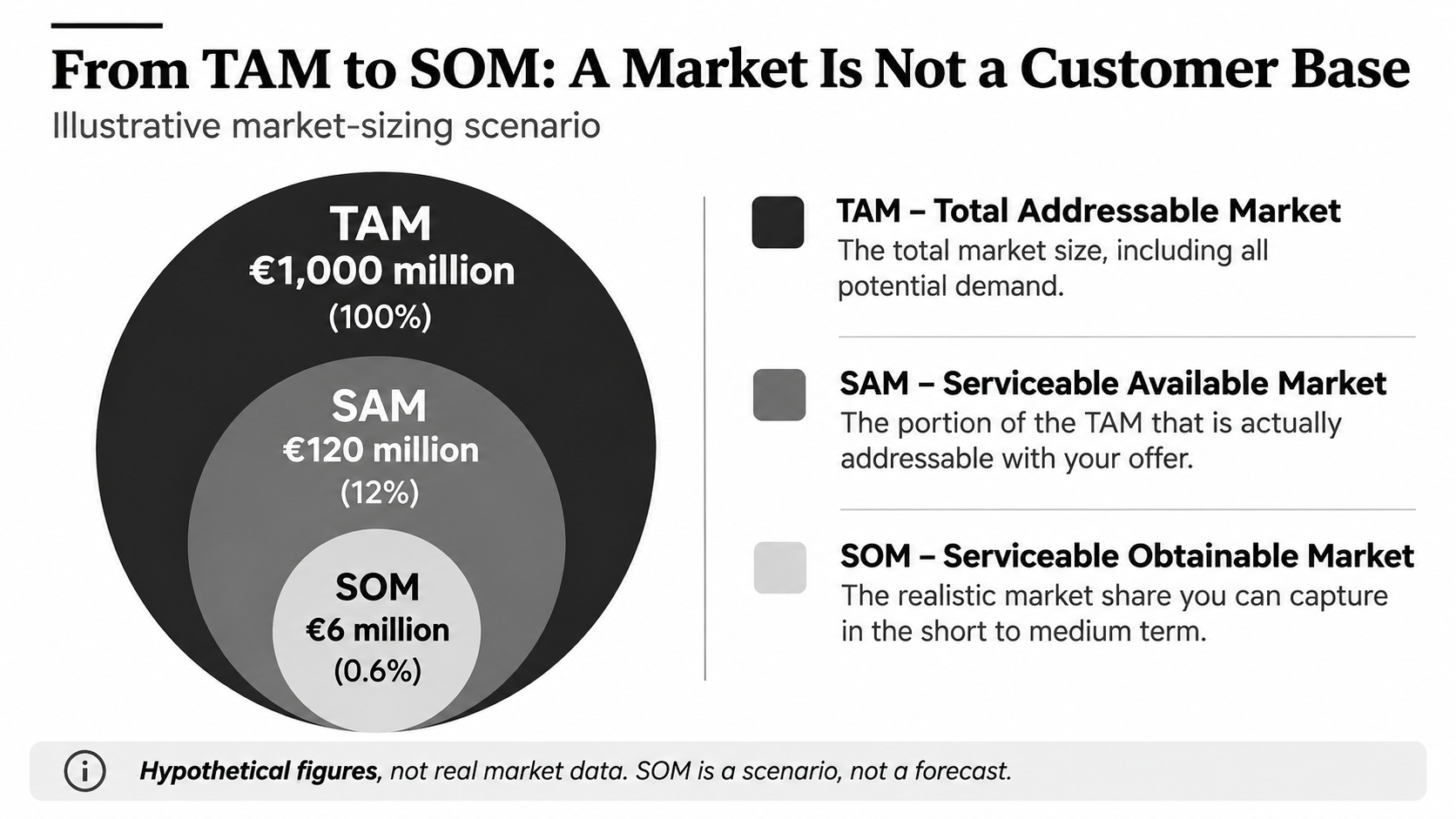
ILLUSTRATIVE SIMULATION — TAM €1,000 million; SAM €120 million, or 12% of TAM; SOM €6 million, or 0.6% of TAM and 5% of SAM. All figures are hypothetical and do not represent actual market data. SOM is a scenario, not a forecast.
Even this more disciplined presentation is only the beginning. To move from a theoretical €6 million to actual revenue, we need to explain how many people or companies will buy, at what price, how often, and through which channels. If a product costs €1,000 a year, €6 million implies 6,000 annual customer equivalents. If the sales process takes three months and the sales team can close fifty contracts per month, the gap between the scenario and operational capacity becomes immediately obvious.
A Bottom-Up Approach Is Less Spectacular, but More Useful
A bottom-up estimate starts with the economic units a company can actually reach: qualified prospects, observed conversions, average prices, purchase frequency, and distribution capacity. It does not eliminate uncertainty, but it reveals where that uncertainty lies. The number of reachable customers can be verified; conversion rates can be measured; prices can be tested. A billion-dollar market, on the other hand, does not answer emails.
Consider a company selling software to small businesses. Knowing that small businesses spend billions on digital services does not tell us how many companies actually experience the problem the product solves, have the budget to address it, can integrate the solution into their workflows, and can be reached through the available sales channels. Research should begin with those conditions, ideally through interviews, sales experiments, and usage data, rather than an elegant multiplication exercise on a slide.
Top-down estimates still have a purpose: they help establish the scale of an opportunity and the competitive context. They become misleading when they replace bottom-up analysis rather than complementing it.
Demand Is Not the Same as Interest
Another misconception arises from the language used to describe potential customers. Interest, need, purchase intent, and actual purchases are different things. Someone can express enthusiasm for a service and never use it. A company can recognize an inefficiency without making it a priority to fix. Between approving an idea and committing money, time, and attention lies a gap that no generic market survey can simply erase.
That is why early commercial experiments often give greater weight to signed contracts, renewals, recurring usage, and demonstrated willingness to pay than to expressions of enthusiasm that require no commitment. Not because these signals tell the whole story, but because they introduce a real cost into the customer's decision.
A Large Market Can Be a Difficult Market
Large industries attract competitors, intermediaries, established operators, and platforms that can afford customer acquisition costs a startup cannot. Market size can also conceal geographic fragmentation, different regulations, incompatible customer needs, and lengthy decision-making processes. Aggregate figures combine opportunities that cannot always be reached with the same product.
Sometimes a narrow segment with an urgent problem and identifiable customers offers better entry conditions than an enormous, undifferentiated market. The point is not to celebrate niches for their own sake, but to understand where a startup can build a credible offering and economically sustainable distribution.
A Market Should Be Explainable, Not Impressive
Good market analysis is not the analysis that produces the highest number. It is the one that allows a reader to reconstruct the reasoning. Which customers are included? Which are excluded? Which assumptions are based on observed evidence, and which are estimates? What would need to happen for the scenario to materialize? Above all, what evidence could prove us wrong?
The billion-dollar market may well exist. What often does not exist is a demonstrated connection between that billion and the startup's income statement. An entrepreneur's job is not to find a number large enough to make a presentation attractive, but to build an explanation strong enough to survive once the presentation is over.
© StartupTheWorld
