


A Great Idea Is Not a Business Model. And the Market Does Not Necessarily Reward the Best Ideas.

There is a remarkably persistent belief in the startup ecosystem: that a company's success is, first and foremost, a consequence of the quality of its idea. It is an understandable belief because it offers a reassuring picture of entrepreneurship, one in which a brilliant insight earns recognition from the market, talent receives its reward, and innovation almost naturally prevails over what came before. Unfortunately, the market, with its customary indifference to romantic narratives, operates rather differently.
An idea can be technically excellent, original in its formulation, and perfectly aligned with a genuine need without there being an economically sustainable business model capable of turning it into a company. The distinction is more than semantic. An idea describes what we would like to build; a business model must explain why someone would pay to use it, how much they would be willing to spend, which channels would reach them, and how much of that revenue would actually remain after covering the costs of generating it.
It is precisely in the transition between these two dimensions that many entrepreneurial projects begin to reveal their weaknesses. The problem is not necessarily a lack of market demand, but rather an inability to capture that demand on economically reasonable terms. A startup might develop a platform that solves a widespread problem, receive positive user feedback, and steadily grow its registrations, only to discover that the cost of acquiring each customer exceeds the economic value that customer can ultimately generate.
At that point, growth stops being good news by default.
The Problem Is Not Convincing the Market, but Understanding It
In investor presentations, the market is often portrayed as a collection of potential customers waiting for a better solution. A customer category is identified, its size is estimated, and a forecast is constructed in which capturing a relatively small percentage of that audience appears sufficient to generate substantial revenue.
The reasoning looks straightforward, but overlooks one detail: having a need does not necessarily mean being willing to pay for a solution.
A consumer may recognize a service's usefulness without considering it important enough to add to recurring expenses. A business may appreciate a technology without being willing to change its processes to adopt it. An industry may display obvious inefficiencies without the people involved having sufficient incentives to correct them.
The question guiding entrepreneurial analysis, therefore, is not merely whether a problem exists, but whether solving it creates enough perceived value to support an ongoing commercial relationship.
Distribution Can Be Worth More Than Innovation
A second misconception concerns the relationship between product quality and the ability to reach an audience. In the popular imagination, the best product should gradually win market share through its inherent superiority. In practice, however, consumer choices also depend on brand awareness, accessibility, habits, switching costs, and trust in a brand.
This means that a technically inferior product can achieve better commercial results when it benefits from more effective distribution channels, recognizable positioning, or an ecosystem that reduces barriers to adoption.
Distribution is not a secondary activity to address once development is complete. It is a structural component of the business model and, in certain markets, may represent the hardest competitive advantage to replicate.
The point is not that innovation has lost its importance, but that innovating and commercializing an innovation are two different capabilities. Confusing them means assigning the product responsibilities that actually belong to the organization, its strategy, and its understanding of customer behavior.
Growth Does Not Necessarily Mean Value Creation
Imagine two startups selling the same service through an annual subscription. Both manage to acquire new customers and increase revenue, but they pursue different commercial strategies.
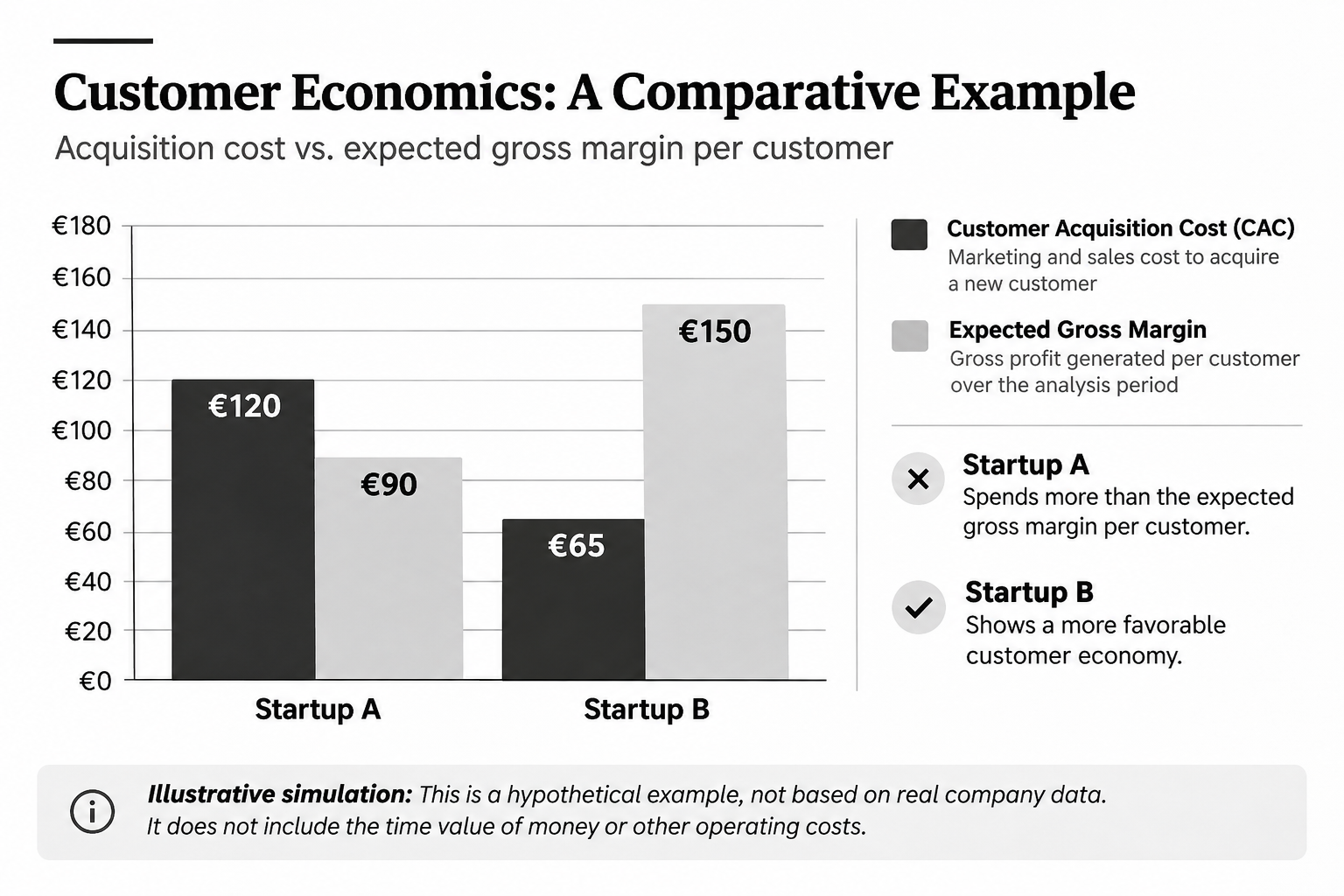
ILLUSTRATIVE SIMULATION — Customer acquisition economics: Startup A: acquisition cost €120, expected gross margin €90; Startup B: acquisition cost €65, expected gross margin €150. These figures are hypothetical and do not describe real companies. The comparison excludes the time value of money and other operating costs.
The first startup acquires customers quickly, but its sales costs exceed the expected gross margin from each customer relationship. The second grows more slowly but builds a more sustainable economic relationship. If we looked only at the number of new users, we might consider the first company more promising. If we analyzed its ability to generate value, our assessment could reverse entirely.
Of course, some models justify substantial initial investment through future revenue, network effects, or economies of scale. The problem begins when these prospects become a universal explanation for every economic imbalance, turning a future possibility into a present accounting certainty.
Scalability is not about indiscriminately multiplying the size of an operation, but about demonstrating that its underlying economics can improve as it grows.
Is the Best Idea the One That Becomes a Business?
Even that conclusion would not be entirely correct. The market is not a perfect system for selecting social, technological, or cultural value. Important innovations can struggle commercially, while highly profitable activities may contribute relatively little to innovation.
What the market measures through transactions is the ability of a particular offering to meet demand that is willing to support its price under specific competitive and institutional conditions. For an entrepreneur, acknowledging this distinction does not mean abandoning the ambition to create something new. It means giving that ambition the tools it needs to confront reality.
A strong project should therefore be able to answer questions less glamorous than those typically found in pitch decks: who pays, why, how often, under what terms, through which sales process, and with what remaining margin.
These questions rarely generate much excitement during a presentation, but they tend to become extraordinarily interesting when it is time to make payroll. Entrepreneurship is not about proving that an idea deserves to exist. It is about building the conditions that allow it to keep existing.
© StartupTheWorld

