


How Much Is a Startup Really Worth? Price, Value, and Expectations

How much is a startup really worth? The most common answer is a number, preferably followed by plenty of zeros. The more accurate answer is a question: worth how much to whom, at what point, and based on which assumptions? The value of an innovative company is not a label attached to its product. It is an estimate of future economic opportunities, the risks involved in realizing them, and the terms on which someone is willing to invest.
This distinction tends to disappear in conversations about million-dollar valuations, where the price paid for an ownership stake is often treated as proof of a project's quality. In reality, a valuation is primarily the outcome of a negotiation, not a market verdict on a founder's brilliance.
Price, Value, and Valuation Are Not Synonyms
Private startups generally lack a liquid market producing an observable price every day. Their valuations therefore emerge from a combination of models, comparisons, and expectations. An investor may assign a high value to a company because they anticipate substantial growth, want exposure to an industry, or believe they can contribute strategically. Another investor, with different goals and time horizons, may arrive at a much lower figure without either necessarily being wrong.
A funding round's price also reflects capital scarcity, bargaining power, shareholder rights, and the prospect of future financing. Two investments with the same headline valuation can have different economic consequences if their liquidation preferences or other terms differ.
Pre-Money and Post-Money: Math Before Narrative
Suppose a startup raises €500,000 at a €2 million pre-money valuation. Assuming no other adjustments, the post-money valuation becomes €2.5 million and the investor receives 20% of the equity. This does not mean the company currently owns €2.5 million in saleable assets, or that the founder can immediately cash out their remaining stake at the theoretical value implied by the round.
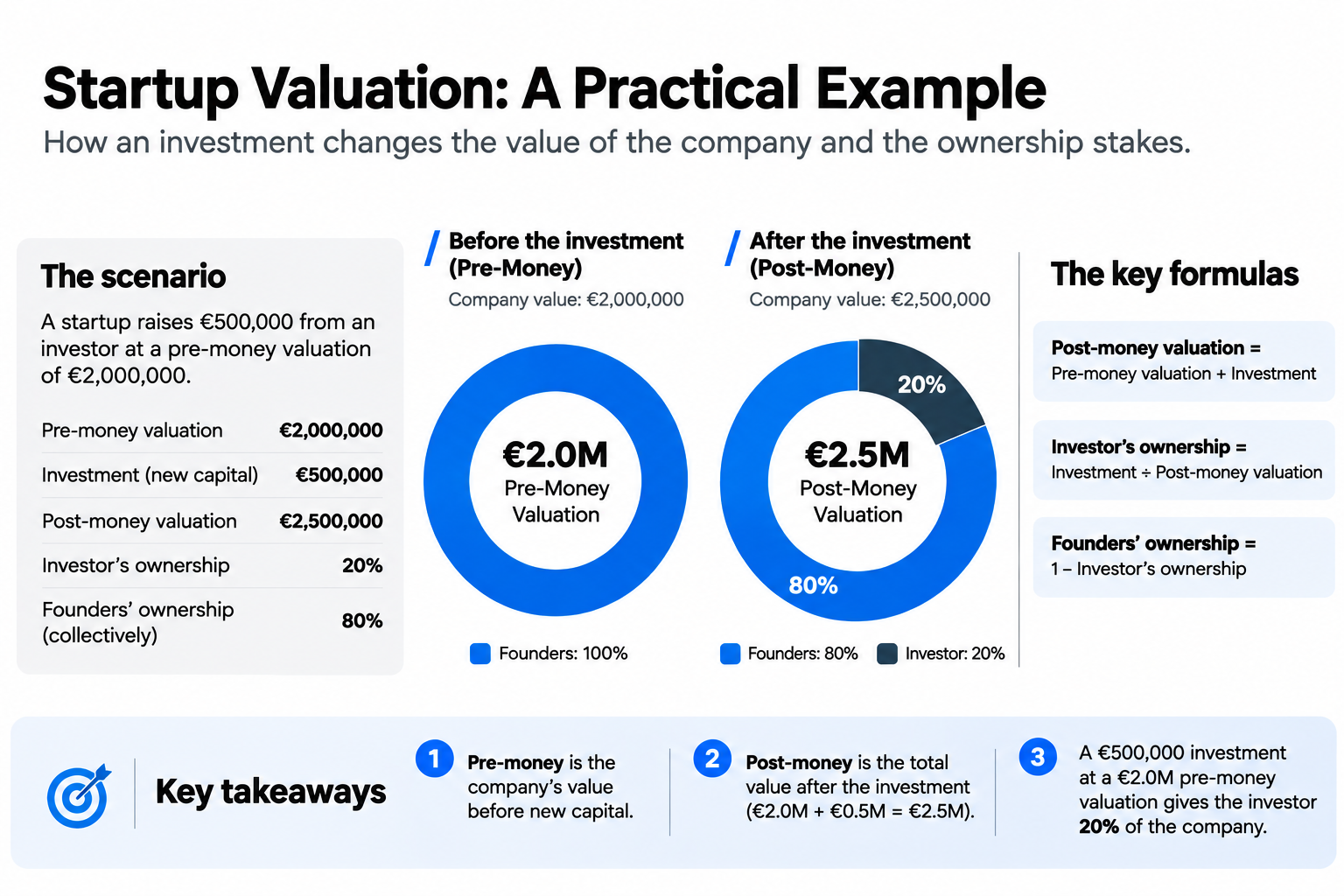
The transaction establishes an entry price for newly issued shares under a particular contract. That distinction matters, especially when comparing venture-backed startups with companies already producing profits and distributable cash flow.
Revenue Is a Fact; the Future Is an Assumption
Recurring-revenue multiples can provide useful benchmarks for software businesses, but they reveal little when margins, retention, customer concentration, and acquisition costs are ignored. Two companies with identical revenue can have radically different prospects: one retains customers and grows with limited incremental expense, while the other constantly replaces lost users by paying to acquire new ones.
Discounted cash flow models also demand caution. For young startups, much of the estimated value depends on outcomes far into the future. Small changes in assumptions about growth, margins, and risk can produce dramatically different valuations. The apparent precision of a spreadsheet should not be mistaken for the precision of its forecast.
How Much Capital Does the Company Actually Need?
A high valuation is not automatically a victory for founders. If a company raises money on terms that assume growth it cannot realistically repeat, the next round may become harder. A more moderate valuation paired with a credible financial plan can offer greater strategic freedom and reduce the risk of unfavorable dilution.
The useful question, then, is not simply what the startup is worth today, but which milestones it must achieve with the money raised to justify a future valuation. Round size should follow operating needs, cash runway, and verifiable milestones—not the desire to appear in a ranking.
Value Is Demonstrated Through Execution
A startup's economic value is inevitably uncertain, but that does not make it arbitrary. It can be supported by revenue quality, customer retention, competitive advantages, team capabilities, and credible assumptions. The more measurable these factors become, the less a valuation depends on the ability to tell a compelling story.
The best valuation is not necessarily the highest one. It is the one that allows a company to finance sustainable growth without turning every subsequent round into a referendum on the previous narrative. Numbers may impress investors for a few minutes; the ability to produce them still matters after the documents are signed.
© StartupTheWorld